
Schools aren't enforcing ISPA suspensions
WRDSB won't—probably because it can't—suspend students on behalf of Public Health.


On April 9th, Region of Waterloo Public Health announced that “704 secondary students with out-of-date vaccination records were suspended under the Immunization of School Pupils Act (ISPA).”
Under ISPA, families must submit either proof of vaccination or a valid exemption. Not disclosing vaccination status is not presented as an option.
Many citizens, including me, believe that neither medical treatment nor disclosure of private health information can occur without voluntary (and informed) consent. Coercive school suspensions are therefore unethical and appear to conflict with existing laws like the Personal Health Information Protection Act and the Health Care Consent Act.
Nonetheless, under ISPA a Medical Officer of Health can “by a written order require a person who operates a school…to suspend from attendance at the school a pupil named in the order.”
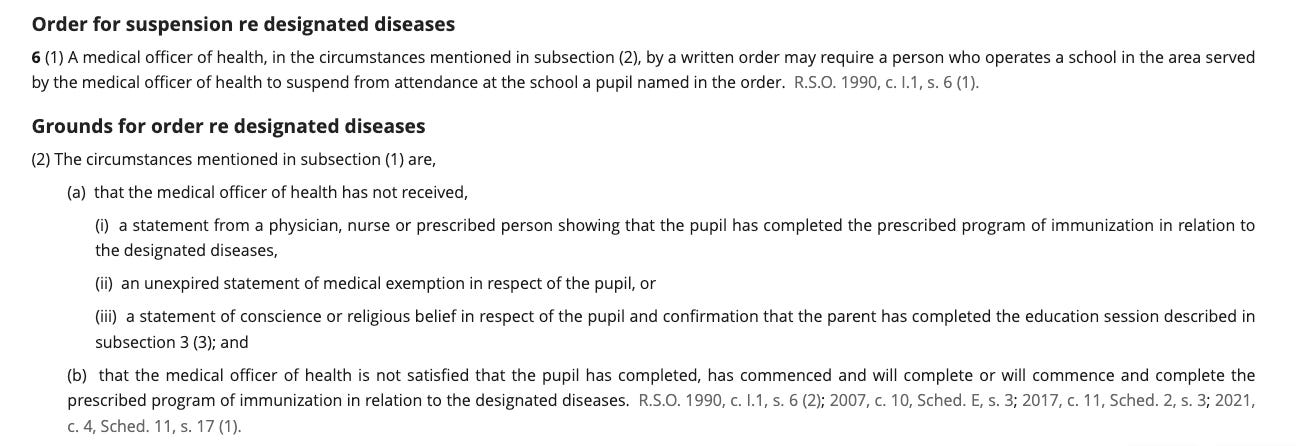
The Region’s announcement was therefore misleading. Students were not actually suspended—Public Health had only issued suspension orders directing principals to suspend; the actual enforcement falls to the school.
But here’s the problem. The Education Act allows a principal to suspend a student only for specific reasons. ISPA non-compliance is not among those reasons.
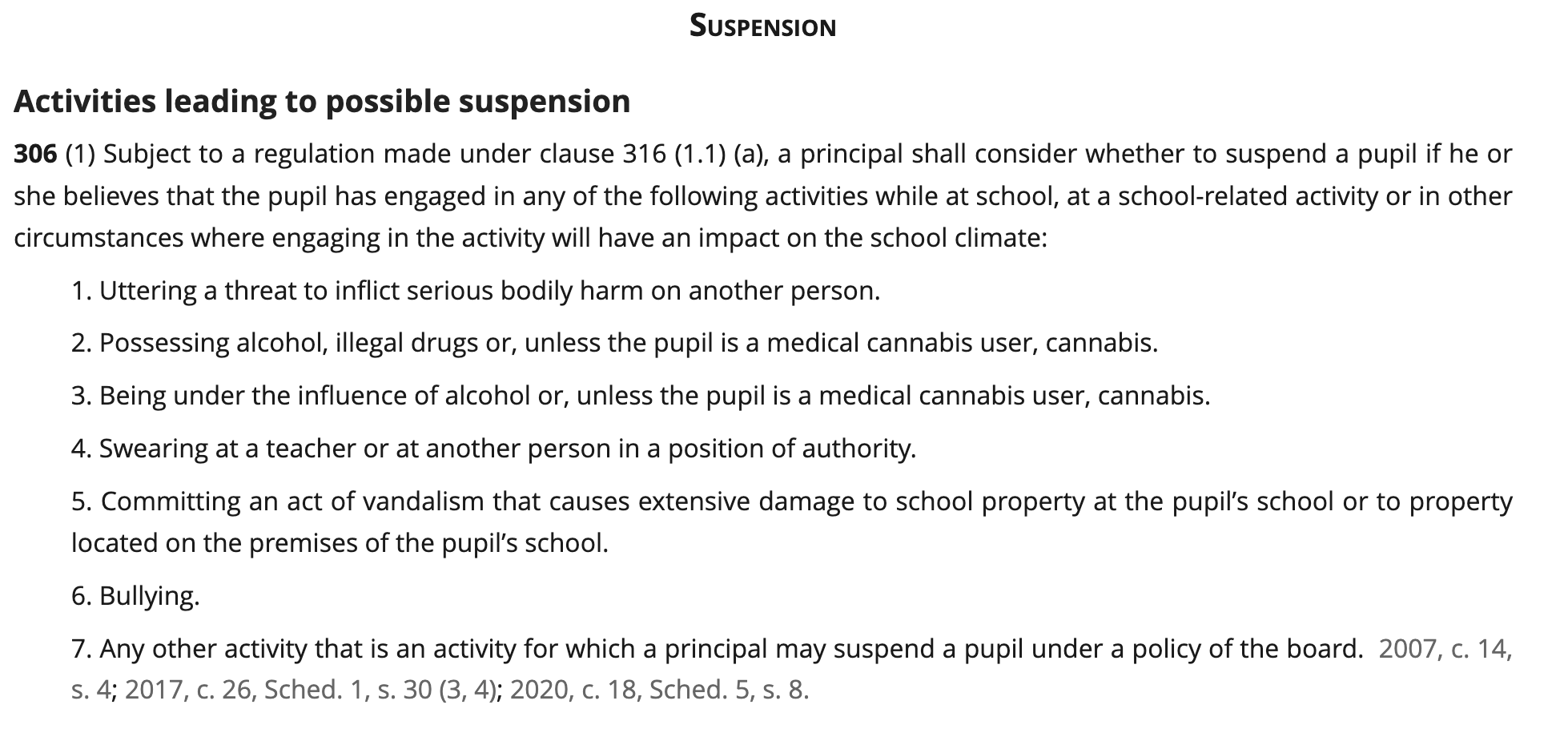
So what is a principal to do?
Currently, schools simply phone parents and request they pick up their children. No written suspension is issued by the school itself.
In my case, I followed the approach described by Cristina Fernandes a couple of years ago. I politely informed my child’s school that we will not comply with ISPA and they are welcome to report our non-compliance to Public Health while leaving my child in class. Should the school choose instead to suspend, I insisted that they provide a signed letter detailing the statutory reason for denying access to education.
Specifically, I requested:
A copy of the written order the school received from Public Health.
A letter on official letterhead stating:
The reason for denying my child access to the classroom;
The exact duration of the denial of access;
The statutory authority (Act and subsection) for the school to deny access for the reason stated above; and
The name, title, and signature of the individual(s) carrying out the denial of access.
All of the learning material and assignments required to continue education for the duration of the denial of access.
I was referred to WRDSB senior management, whose lawyer came back with the following message:
As a publicly funded statutory institution, we are required to comply with provincial law, and part of our responsibility pursuant to the Immunization of School Pupils Act is to suspend students who are subject to an order of the Medical Officer of Health.
Your position that the Education Act must grant power to the principal to suspend based on an order of the Medical Officer of Health is a misinterpretation of the application of the WRDSB’s statutory duties. There is no conflict of law.
The public health policy reasons for the suspension are not an issue for the WRDSB to debate with you. Nor do we want to debate whether the WRDSB could be subject to an order of mandamus.1
I responded to the Board that, given their apparent legal confidence, accompanying a suspension with paperwork shouldn’t be a problem. I reiterated that I do not consent to my child being removed from class without any written documentation, which I consider a reasonable expectation consistent with due process, transparency, and accountability.
When the school’s Vice-Principal phoned requesting we pick up our child, I politely but firmly stood my ground. I emphasized that I did not consent to my child being removed from class until I had received the requested paperwork. Because the VP was not included in preceding emails, I promised to loop him in to the discussion. I immediately emailed the VP my previous request for documentation, copying the senior managers already in-the-know.
My child remained in class and I received no further communication from the school.
But the next day I received the following message from the Superintendent:
These questions were answered in a previous email. The board's process meets the legal requirements outlined by ISPA. Any further questions about ISPA can be directed to your local MPP. I consider this matter closed.
What are we to make of this?
Here’s my conclusion. The Board seems to claim that it must, and lawfully can, suspend students when ordered by Public Health. But if that were true, why won’t it do just that?
The simplest explanation is that the Board knows full well that it cannot lawfully suspend—so it won’t put anything in writing.
But this leads to a further mystery. If the Board doesn’t document ISPA suspensions, then why bother at all? How can the Board even prove that it is complying with Public Health suspension orders? (Perhaps Public Health and WRDSB have unofficially adopted “don’t ask, don’t tell”).
In other words, why is the Board voluntarily requesting parents to remove their children from school, and why are parents voluntarily complying? The answer, I believe, does not reflect well on the current state of our society.
Properly functioning democratic institutions do not fear transparency, due process, and accountability. When public institutions reject these foundational principles, it is time to revisit their relationship with taxpayers.
I had asked the Board if they ever faced legal consequences from Public Health for not suspending students, or not excluding students from school for the full 20 days. A superintendent told me he was not aware of any legal consequences. In fact, Public Health is more likely to pause suspension orders than to double down and order removal of large numbers of students.
 | A guest post by
|
Well done ! More families Standing Their Ground and guiding their sons and daughters in the fine art of re-establishing their authority. This is not a “fight”...this is us remembering who we are and no longer voluntarily allowing the PHU’s overreach into the matter of our personal and protected medical identities / business... much less using our young sons and daughters, educators and educational institutions to coerce our compliance. Fear tactics quit working 5 years ago for even those who had not yet become aware of the situation we were facing. More families who sit on both sides of the "vaccine choice" are joining in the collective effort to protect our fundamental freedoms and rights to specific things - access to educational venues, and not only medical autonomy but privacy and protection of our sensitive records.
Congratulations. WRDSB is among the most secretive and authoritarian school boards in Ontario. Ironic how pushing back silenced them. Usually, they are the ones silencing parents.
Good work.
Sidenote: Alas, Calaranda ( sp?) dropped the ball by keeping trustees. The elite 8 led by Scott Piatowski will continue their ideological roadmap. Presumably, they are smiling having dodged a bullet.